
Read the room
First the shoes, then the eyes

One of my clients remarked, “I left that meeting and still have no idea what they were really saying.”
She is in a senior executive position at a company so large that she no longer remembers everyone’s name. When she had looked through the list of names on the invitation to an in-person meeting, she had made it a point to find out who was coming. She tried to interject, ask questions, and make sure everyone knew what she also believed. After she had left the meeting, she told me that she didn’t understand where each person was coming from, as though she needed an interpreter; she couldn’t read them.
Rather than offering her a direct answer, I chose to illustrate my point with a story.
On the second floor of the Museum of Modern Art in New York, a woman who was 63 years old sat down in a wooden chair on March 14, 2010.
She remained there for nearly three months. The rule she set was that she’d be in the chair for every minute the museum was open, arriving before doors and staying past close.
Marina Abramovic remained silent and did not get out of the chair. On the floor there was a rectangle of tape, one empty chair facing hers, and a line of people waiting to use it. Anyone was free to sit down and could stay there as long as they liked.
When it finished on May 31, the total time she had sat was 736 hours and 30 minutes, spent facing 1,545 different people.
People broke down in that chair. Adult individuals sat down opposite a woman they didn’t know, said nothing, and were crying within a minute. One person started a blog called Marina Abramovic Made Me Cry and posted only their faces, each face accompanied by a caption stating how long they had stayed seated. The duration was seven minutes, then eleven minutes, and one person remained seated for 391 minutes. A makeup artist named Paco returned 21 times and had the time tattooed on his arm.
On opening night, a man walked up and took the empty chair. It was Ulay. They had been romantic and creative partners for twelve years. In 1988 they started at opposite ends of the Great Wall of China and walked toward each other for ninety days. The plan was to marry when they met in the middle.
But they had spent years waiting on the Chinese government for permission, and the relationship died somewhere while they were waiting. They walked it anyway. What they handed each other in the middle was a goodbye. Twenty-two years after that walk, he sat down across from her with no warning. She broke her own rule, reached across the table, and took his hands.
Later, a person asked her what she had been seeing in all those faces. The thing she had been reading for 736 hours.
The response given was nothing that anyone had anticipated.
“I know the shoes and the eyes, not the body, because I always look at the shoes and then eyes.”
We start with the shoes, then the eyes; that’s the entire process.
Then she said the part that really counts.
“I am just a trigger, I am just a mirror, and actually they become aware of their own life.”
She wasn’t reading them at all.
They were crying over their own situations. She didn’t provide them with anything to perform. There was no expression for them to interpret, no indication of how they were coping, and no face to respond to them from the chair. And in that silence, each and every person came up against the only thing remaining in the chair - themselves.
When you walk into a room and start working it, the room stops showing you anything true. Everyone adjusts. They’re reading you, reading them. You’re all doing a live edit of each other and calling it a conversation.
It is harder to read a room when you are performing.
The notion that reading a room is simply a matter of increasing our observation by scanning for more signals or processing information more quickly is misguided. Genuine understanding isn’t from heightened performance or attentiveness, but from removing ourselves from performing.
Stepping back and allowing the interaction to unfold without intervention allows underlying dynamics to become apparent.
You don’t fail to notice the room because you aren’t paying attention; rather, you fail to notice it because you’re occupied in acting as one of the people in it.
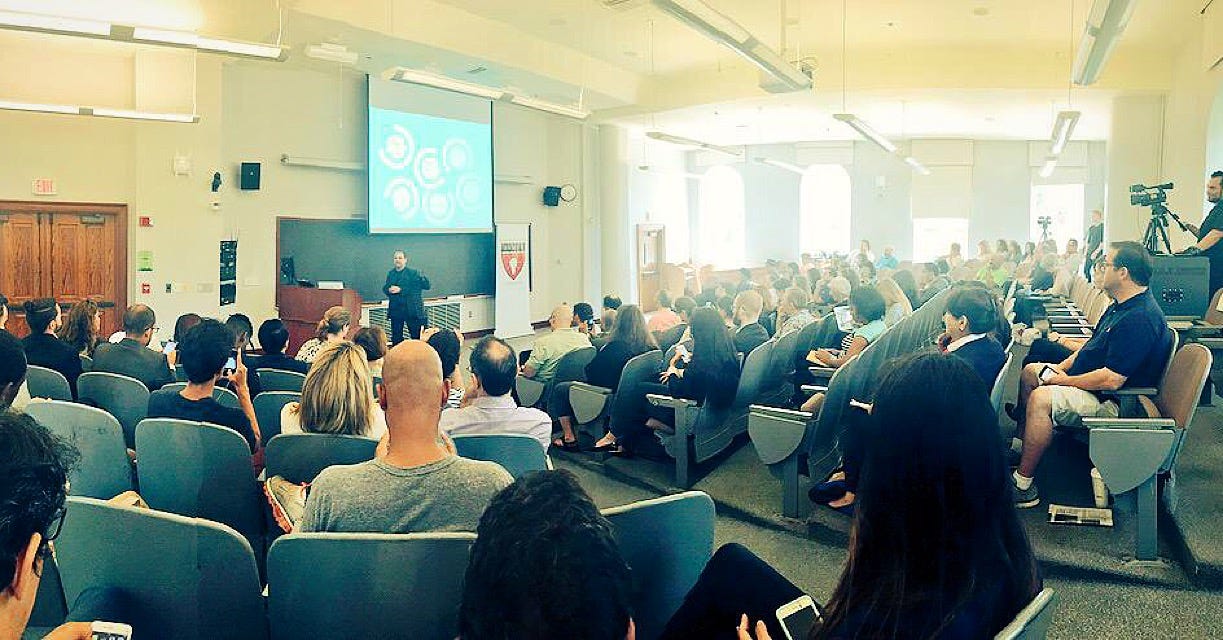
I once taught a class at Harvard Business School, and I asked the audience to pick a partner they don’t know and simply gaze into their eyes for a full minute.
The giggles always start. For the ones who allow each other to go deeper beyond the nervous chuckle, they start to get quiet, then some begin to tear up, and then when it was done, they hugged as if they knew that person so deeply. Just one 60 seconds that feels like a lifetime.
Our inclination is to start performing or filling the air. Yet, that’s not always helpful for seeing.
Tell me. When are you performing instead of leaning in?
Try approaching this on a smaller scale than you might anticipate. At your next meeting, start with one person. I am not suggesting that you create discomfort or awkwardness; rather, resist the impulse to prepare questions in advance or to plan your responses.
If necessary, begin by briefly noticing their shoes, then their eyes, and allow a brief silence, just two seconds longer than feels natural. Genuine understanding starts when we relinquish our performative tendencies and allow our authentic presence to reveal what’s actually happening in the room.
Then lean in.
Stay human
-Bryan
P.S. Have you ever been in a room or with someone who was hard to read?
I’m Bryan. If you lead people, pull up a chair.
Before all this, I built companies in Silicon Valley, gave a TED Talk, and spoke at 250+ conferences. I wrote a book called Human to Human: H2H. It started a movement I’m still catching up to.
Then I hit a new bottom; we all do. 85 pounds gone. Diabetes reversed. Sober. I moved to Lisbon and found out you can rebuild the whole thing at any age.
Now I work with leaders who’ve already won, and want more without burning themselves down to get it.
Press subscribe. Stay human.
Popular Posts:
Connected Detachment - The looser the grip, the longer it lasts.
Main Character Syndrome - The scene starts when you walk in.
10 Days of Silence - I stopped speaking for ten days. The noise I found was mine.
Great piece!
I was fortunate enough to see an exhibition about Maria Abramovic, including her life with Ulay and most importantly her experiment you described here in Zurich, in the Museum of Modern Art. The faces of the people were also displayed accompanied by a video of the scenes. All of them still vividly live in my memory, it was a significant experience.
The eye gazing experience I have myself with the same results as you described. I have never found any other deeper human connection than that for myself.
Silence, as mirror, has immense power to transform. I have been trusting it both in my coaching and in my meetings ever since. It brings tears, smiles, deep thoughts, insights and ultimately freedom.
Thank you for writing about this, it is powerful especially when comes in the executive context.